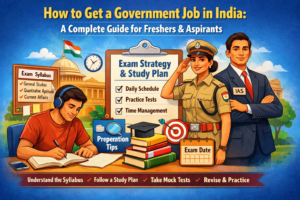
Government jobs in India are more than just a career choice; they represent stability, respect, financial security, and long-term growth. Every year, lakhs of aspirants compete for limited vacancies, yet only a few succeed. The difference lies not in intelligence, but in strategy, consistency, and correct guidance.
This blog will walk you through a step-by-step roadmap to crack government jobs in India, even if you are starting from scratch.
Why Government Jobs Are Still in High Demand
Before jumping into preparation, it’s important to understand why government jobs continue to attract massive competition:
- Job security and fixed working hours
- Attractive salary with DA, HRA, pension, and medical benefits
- Social respect and authority
- Opportunities to serve the nation
- Work-life balance compared to private jobs
Because of these benefits, competition is intense and preparation must be smart.
Types of Government Jobs in India
Understanding job categories helps you choose the right exam based on your qualification and interest.
1. Central Government Jobs
- UPSC (IAS, IPS, IFS)
- SSC (CGL, CHSL, MTS)
- Railways (RRB NTPC, Group D)
- Banking (IBPS, SBI, RBI)
2. State Government Jobs
- State PSC exams
- Police, teaching, clerical roles
- State-level engineering and medical posts
3. Public Sector Undertakings (PSUs)
- ONGC, BHEL, NTPC, IOCL
- Mostly through GATE or direct recruitment
Step-by-Step Guide to Get a Government Job
Step 1: Choose the Right Exam Early
Do not prepare for everything at once. Select one or two exams based on:
- Your education
- Age eligibility
- Interest (desk job, field job, technical, administrative)
Focused preparation beats scattered effort.
Step 2: Understand the Syllabus & Exam Pattern
Many aspirants fail because they don’t study the right topics.
- Download the official syllabus
- Analyze previous 5–10 years’ question papers
- Identify high-weightage topics
This step alone can increase your success rate by 30–40%.
Step 3: Build a Realistic Study Plan
A smart study plan includes:
- Daily targets (not vague goals)
- Revision days
- Weekly mock tests
- Buffer time for weak subjects
Consistency matters more than long study hours.
Step 4: Master the Basics First
Most government exams test concept clarity, not advanced knowledge.
Focus on:
- Quantitative Aptitude (basic formulas & speed)
- Reasoning (logic & patterns)
- English (grammar + comprehension)
- General Awareness (static + current affairs)
Strong basics = faster problem-solving in exams.
Step 5: Practice Mock Tests & Previous Papers
Mock tests are not optional—they are mandatory.
Benefits of mock tests:
- Improve time management
- Reduce exam fear
- Identify weak areas
- Increase accuracy
Analyze every mock test, not just scores.
Step 6: Stay Updated with Current Affairs
Current affairs play a crucial role in:
- SSC
- Banking
- UPSC
- State exams
Daily routine:
- Read news for 30 minutes
- Make short notes
- Revise weekly & monthly
Avoid information overload—quality matters.
Common Mistakes Aspirants Must Avoid
- Preparing without a plan
- Following too many sources
- Ignoring revision
- Avoiding mock tests due to fear
- Comparing your journey with others
Remember, government job preparation is a marathon, not a sprint.
How Long Does It Take to Crack a Government Job?
There is no fixed timeline, but on average:
- SSC/Banking: 6–12 months
- State exams: 8–14 months
- UPSC: 2–3 years
Success depends on discipline + direction, not luck.
Your Government Job Is Possible
Thousands of candidates crack government exams every year—and most of them start exactly where you are today: confused but hopeful.
If you:
- Start early
- Stay consistent
- Prepare smartly
- Believe in yourself
Then your name can be on the final merit list too.
Government jobs are tough—but you are tougher





Leave a Reply